The Lost Coder
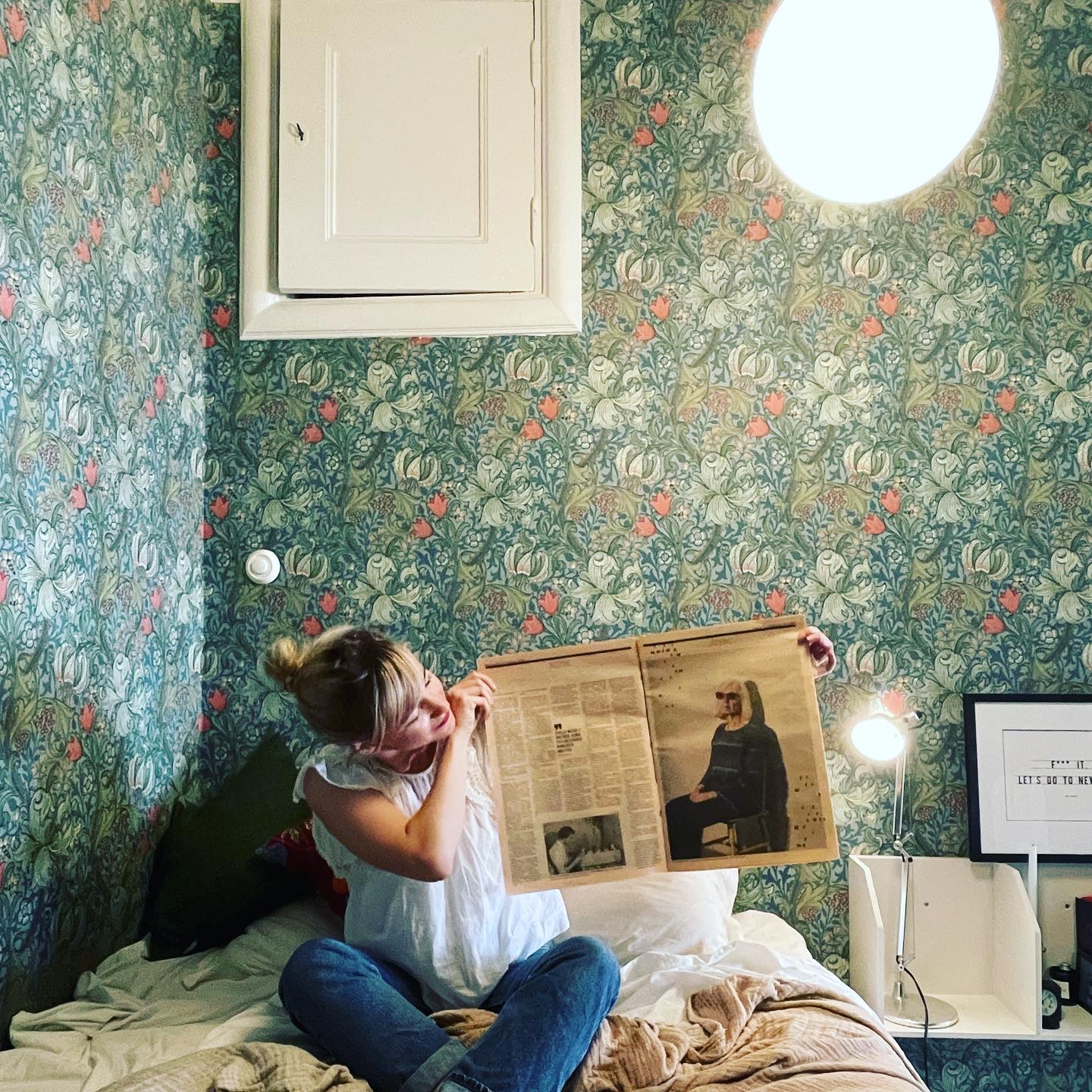
This essay was originally published in Helsingin Sanomat on August 14, 2021. The original story included interactive games to test your punchcard operator skills. I also wrote about the experience and themes in my newsletter No. 23. Translated by Christina Saarinen.
* * *
My name is Linda Liukas. I write and illustrate, for a living, of children's books about computer science.
In my books, a little redheaded girl named Ruby learns the basics of programming, is introduced to packet transmission, and dives into the world of machine-learning algorithms.
My books have been translated into more than thirty languages. I've been around the world talking about my books, and while I'm at it, I usually also talk smoothly about equality in Finland—how it's a country that believes in women, technology, and education.
I have a secret, though. I can't name a single Finnish female programmer from decades ago.
When it comes to Americans, I know many.
Katherine Johnson, Dorothy Vaughan, and Mary Jackson worked for the U.S. space program in the 1960s. They were African-American women who calculated flight paths for the Mercury space program and who programmed the IBM 7090 computer. They've even had a movie made about them.
Margaret Hamilton was a software engineer who worked for the Apollo space program. She developed in-flight computer programs for spacecraft. Her programs did things like safely land the moon module.
In an old black-and-white photograph, Hamilton poses next to a towering stack of paper, her long hair hanging loose. The paper is a printout of the entire landing code of the Apollo 11 moon module. The stack reaches the top of her head.
And then there's Hedy Lamarr, the soft-eyed Hollywood star and inventor. During World War II, she invented a radio signal that jumps from one frequency to another. Her invention made it harder for the enemy to disrupt torpedoes traveling underwater.
When my American colleagues casually drop the names of these female programmers, I always feel a pinch in my stomach.
Flustered, I say something about Finland's divided labor market of the 1960s. How after the war, women ended up in the public sector or in care work, not in the private corporations where the computers were presumably being built.
I can hear the uncertainty in my voice. There must be women in Finland, too, who advanced coding culture and were part of the story of computers?
Surely we, too, calculated flight paths and predicted air pressure changes?
* * *
The hunt for Finnish female programmers must begin with Finnish computers.
The first was as tall as a man and weighed about two tons. It was named, aptly, ENSI, which means 'first' in Finnish.
At a celebratory launch in October 1958, Finland's minister of finance, Päiviö Hetemäki, booted up the country's first computer at the Postal Savings Bank.
ENSI was an IBM 650, which was the world's first mass-produced electronic "data processing machine." It read commands from a punched card.
The instructions given to the machine were "programmed" by punching holes in rectangular strips of cardboard. The placement of the holes represented the information the card was intended to express.
The acquisition of the IBM 650 had been preceded by a fierce race for Finland's first computer. A few years earlier, a Mathematical Machine Committee had been set up to "study the need for mathematical machines in Finland and possibly make proposals for their acquisition or construction."
Funds were scarce, so the committee decided to copy a design from Germany instead of starting from scratch.
When the committee's computer, ESKO, the 'Electronic Serial Computer,' was finally completed in 1960, it was already hopelessly obsolete. It used a similar technology to the Postal Savings Bank's ENSI computer, reading its commands from holes punched in paper. But instead of punched cards, ESKO read punched paper tape, which was faster.
Soon, computers were being used by the public sector, by insurance and telephone companies, and by the military. The new miracle device was used to build the results reporting system at the Helsinki Olympic Stadium and to control the stage lighting at the Helsinki City Theater.
Computers were wrapped in a kind of patriotic fog. They were being used to build a modern Finland. But where were the women?
* * *
One night I find myself on Finna, a discovery service that brings together the materials of hundreds of Finnish museums, libraries, and archives. On a whim, I type in the keyword 'programmer' and start browsing through pictures.
And there I find them.
In a photo taken in 1964, a group of resolute women sit in rows. The caption says keypunch operators.
I'm thrilled. In a way, punching holes into punched cards was coding, and these women were some of the first programmers.
I want to know more about them.
Did any of them go on to program on modern computers? Did they come up with new ways to use punched cards effectively? Who exactly were they? Why don't we know their stories?
Some of these women are still alive. And there is much that remains to be told about the recent history of the computer.
* * *
The mood in the National Archives of Finland is reverent and dusty, as if straight out of Harry Potter. An expanse of leather-bound books stretches across three stories. Other than me, one elderly genealogist sits in the ornately carved straight-back chairs of the reading room.
I have reserved a thick volume in advance. The first page is red and reads "Reikäkortti 1/1955." It's a bound collection of 'Punched Card' magazines, one of the few surviving public sources of 1960s computer culture.
The Finnish Punched Card Association was founded in the 1950s to provide a forum for those working in the emerging industry to share their experiences. Later, in 1961, the magazine was renamed Tietokone, 'Computer.'
But this is where it all started.
I turn the pages slowly. They are full of abbreviations and expressions that all sound a bit like something you would find in a comic book:
ESKO, the Electronic Serial Computer.
Universal mathematics machines.
Program pulses.
The diagrams describing computer programs look like knitting charts.
In more than ten years of magazine issues, I spot only a few female writers. In an ad, a beautiful, slender keypunch operator sits beside a machine that fills the whole room. The caption reads, "Does the girl come free with the purchase?"
Once again, we're in a world of young men. They stare at me out of the pictures, wearing their skinny ties, visibly proud.
* * *
But then I think I'm onto something.
In 1958, the board of the Punched Card Association organized a competition to encourage innovation and disseminate the tips and tricks that people had come up with.
The tricks needed to somehow involve the use of punched cards. First prize was 5,000 Finnish markkaa.
I hold my breath. This is exactly the kind of practical skills I was hoping to find. Somewhere in accounts receivable, inventory management, or payroll sits my keypunch woman, ready to dash off a letter to the association detailing her innovation.
I read a description of a new tabulation routine for daily dough quantities at Karl Fazer's confectionery and get acquainted with a trick related to programming payroll runs and deductions on a punched card.
Filled with hope, I scan the names of the authors of each contest entry. An initial is often given instead of a first name: H. Levas. G. Tollet. M. Kurimo. E. Välilahti.
I research the names in vain. Not a single one belongs to a woman.
* * *
When I think about the history of programming, it's men who come to mind, the names that almost everyone recognizes: Larry Page, Bill Gates, Mark Zuckerberg.
But in the 1950s and '60s, programming was a woman's job.
'Computer' was once the job title of the women who, during World War II, used pen, paper, and mathematical models to calculate the flight trajectory of missiles.
A single trajectory required thousands of small calculations, which the women crunched through. Later, computers helped with these calculations, but the women's roles as clerks remained.
Programming was not considered particularly demanding, and programmers were not considered geniuses. Quite the contrary. Programming was a bit like being a telephone operator, a task that was suitable for precise and conscientious women.
Young men in their twenties were considered too unreliable for the job.
That's why it's called 'software' in English, giving the idea that it's soft, sweet-sounding, easy. Hardware, on the other hand, is cumbersome and challenging. You need to be an engineer to be in charge of hardware.
By the 1970s, however, it was apparent that writing code was challenging, creative, and most importantly, profitable. It was time to recruit mathematically talented young men to raise the industry's profile. Job aptitude tests, which until that point had measured accuracy and speed, were twisted to fit the new idea of a programmer.
And we've been on that path ever since. The first programmers, those keypunch operators and human computers, are forgotten history.
* * *
"Really tries, but a little slow at everything."
"Reliable, good comprehension."
"Trying, but not able to learn quickly."
This is how managers describe a group of keypunch operators in a master's thesis written by Leena Relander in 1965, which I find in the University of Helsinki archives. In her thesis, Relander designed an aptitude test for Finnish keypunch operators.
The thesis immediately captures my interest. It was through aptitude tests that the industry was manned in the United States.
The purpose of Relander's twelve-minute test was to assess perceptual speed and accuracy. The test was used by employers such as Kela (the Finnish social insurance institution) and the national Motor Vehicle Registration Center.
The average age of the test-takers was 24. Nearly all were women.
"The results of the few male subjects who took the test have not been included in the study because men perform keypunch tasks only in exceptional situations," Relander writes.
* * *
I think about those women who took the keypunch test in the early 1960s.
Perhaps they saw a notice about it posted on a library wall or at their workplace: "Hiring keypunch operators."
The job must have sounded exotic. The operators made the punched cards that were read by the first computers in human history.
It was the future. Well-paid office work that they could certainly be proud of at home.
A new book by Pekka Kuusi, Social Policy for the '60s, had just been published. People in Finland were reading about child benefits, survivor's pensions, and other welfare-state ideas. There was great faith in the future.
In the aptitude test, subjects searched for identical patterns in series of dots, did multiplication problems, and found typos in pairs of texts, all against the clock.
They were tested in skills that, today, a machine would easily best a human at. These days, we wouldn't select programmers this way.
On the other hand, accuracy, perceptual skills, and the ability to find errors are still important traits for a programmer.
I'm starting to understand why keypunching isn't generally considered to be programming. Today, those kinds of tasks are handled by computer, while the programmer focuses on problem-solving. But that doesn't mean the work was easy. You can try it for yourself.
Accompanying this article is a series of tests designed to predict the future success of those seeking to become keypunch operators.
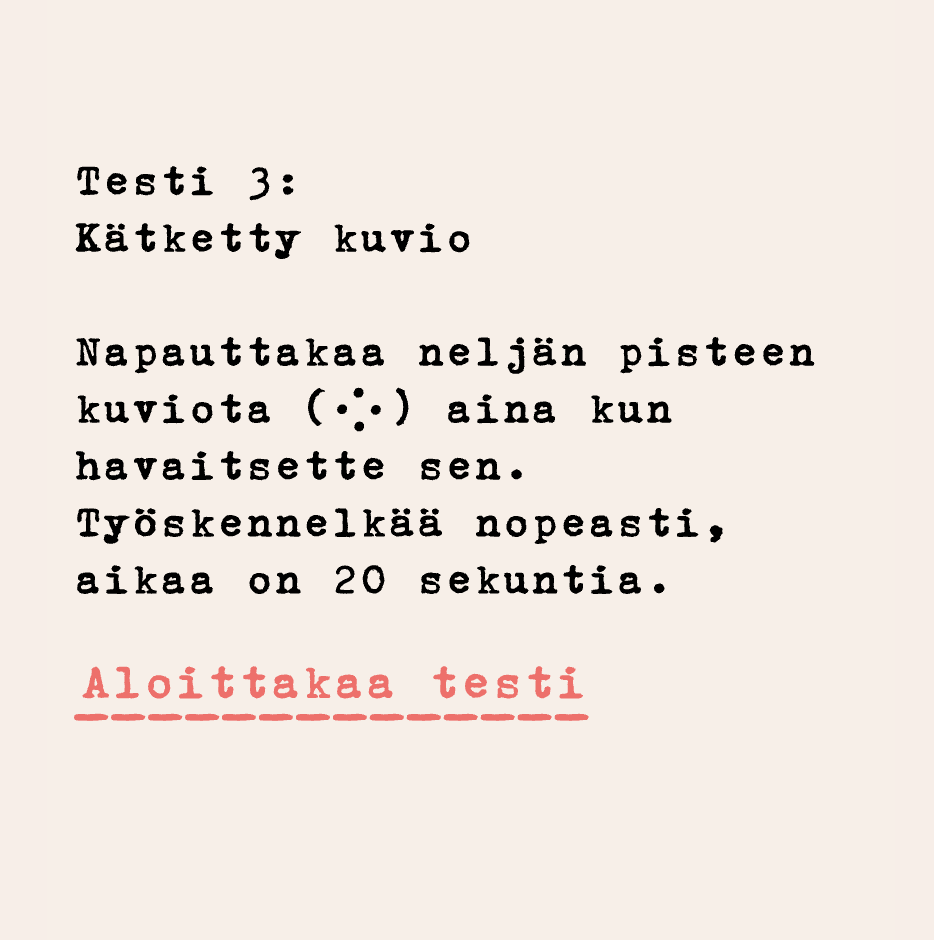
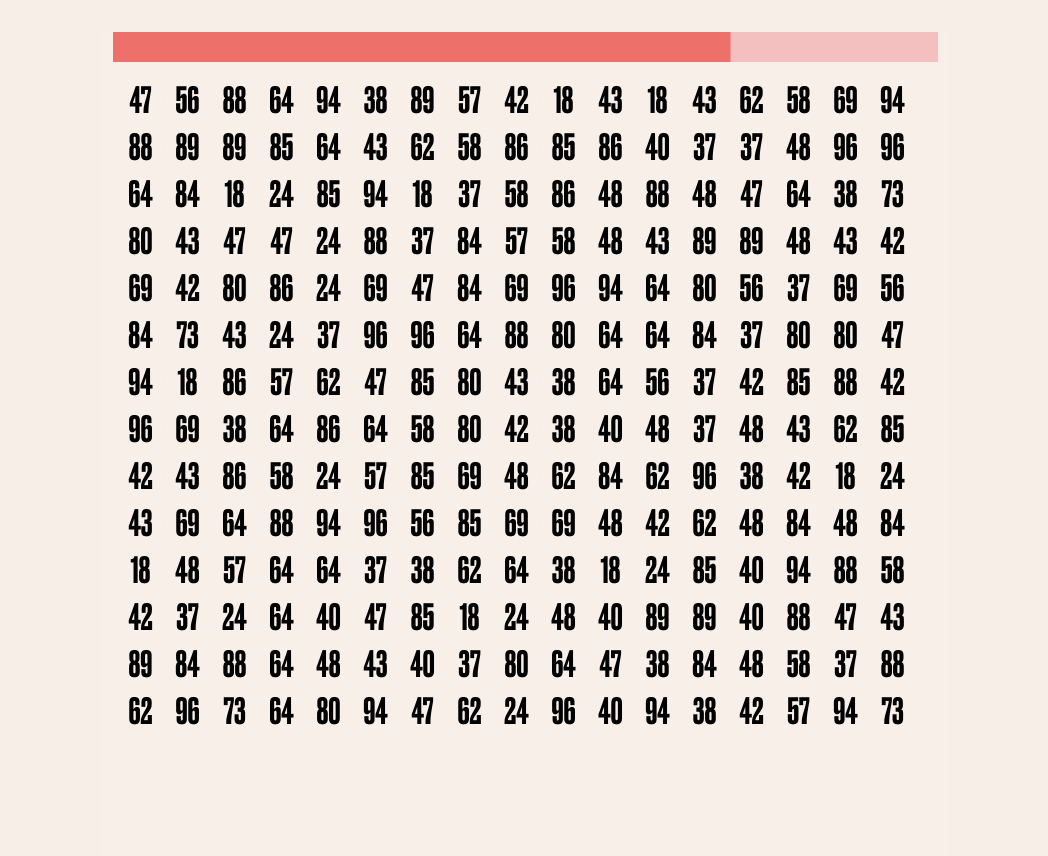
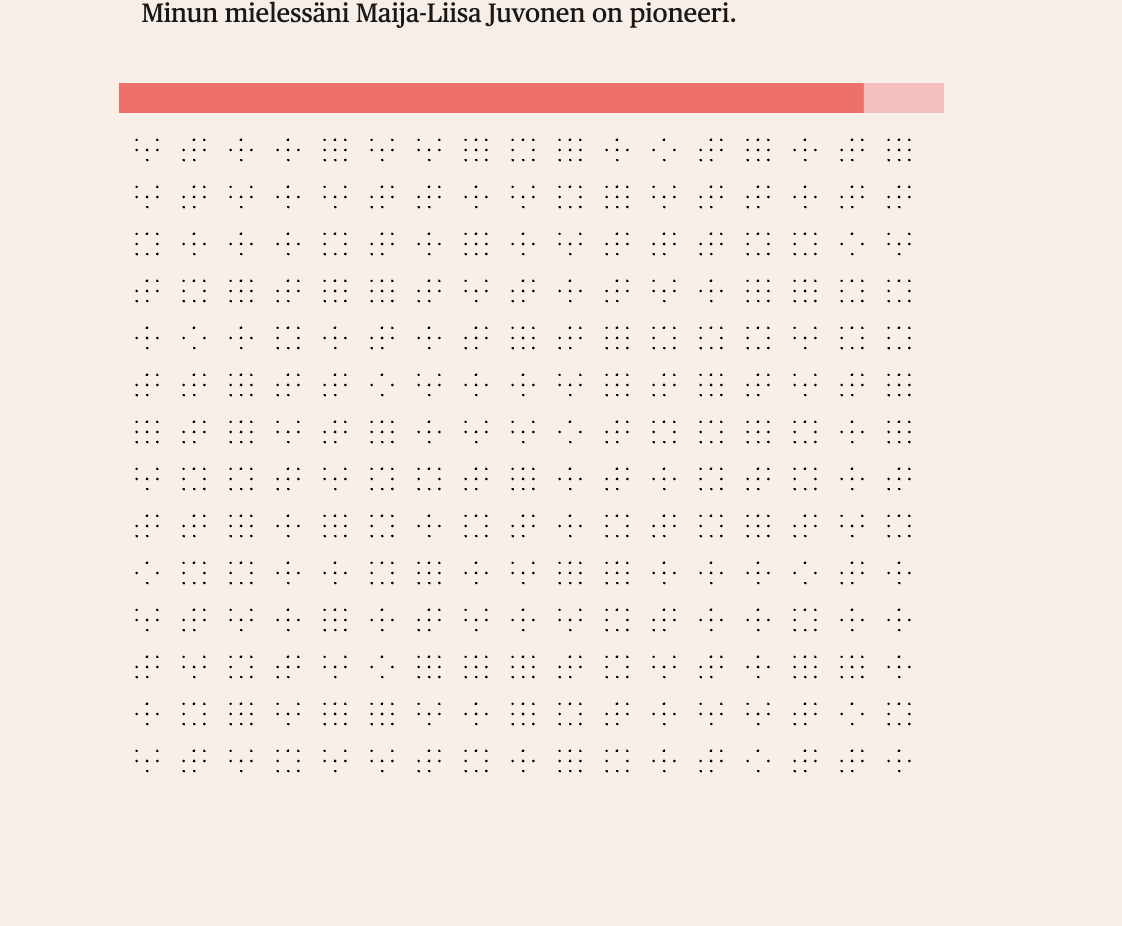

The tests are based on Relander's thesis. Relander's original test consisted of ten parts and had a time limit of twelve minutes. Both speed and accuracy were measured. The test here will not predict your success as a keypunch operator, but it will give you an idea of what the work was like.
A good operator handled a few hundred cards an hour. A maximum of five erroneous cards was allowed. That means two cards per minute, with about eighty characters per card, hour after hour.
* * *
In 1973, Maija-Liisa Juvonen, a department manager at Kela, gave a lecture for the Data Processing Association on the topic "Can Keypunch Work be Enriched?"
I wonder about that too.
I request an interview. Juvonen agrees and invites me to her home in Käpylä, Helsinki.
Juvonen is 98 years old. She worked as a keypunch trainer at Kela from the 1960s until her retirement. Hundreds of young operators worked under her direction.
"My job was to make sure that the work in the data input department was done in the right order," Juvonen explains.
The keypunch operators worked in two shifts.
"There were differences among the operators, of course. Some were faster and more accurate than others. One girl might be able to write five hundred people's data in one day."
A driver traveled many times a day from Lauttasaari, the island in western Helsinki where the keypunch office was located, across the bay to where the computer was in Salmisaari.
"There was a huge number of boxes. But after all, we had every Finnish citizen on the books."
In addition to computer programs, operators encoded directories, lists, names, and other data onto the cards.
Making bits on a punched card required precision, dexterity, and patience. One card could hold only about eighty characters, so huge numbers of cards went through the hands of the women in the keypunch department.
The amount of information stored on the cards was modest. Today, one five-megabyte photo, three minutes of music, or a thousand pages of text would require more than 60,000 punched cards.
* * *
Initially, the cards were punched with a hand perforator, a metal device the size of a matchbox, through which holes were made in exactly the right spot with an awl, character by character.
Later, a keypunch machine was acquired for the card punchers. The machine enabled operators to write characters directly on the cards with a keyboard.
"Before long, we transitioned from punched cards to tape. It was easier and faster," Juvonen says.
On Juvonen's balcony, we browse through black-and-white photos of Kela's young keypunch operators, sitting at their machines and smiling.
Lenita Airisto's generation, I think—a Finnish woman who made herself visible in boardrooms and on television when women were expected in neither. Kennedy has been elected president, and the Apollo space program is just beginning.
Did these women understand their own role in the technological revolution?
At almost one hundred years old, Maija-Liisa Juvonen continues to follow the tech industry and reads science fiction; she ponders the future.
In my mind, she's a pioneer.
* * *
Keypunch operators played an essential role in the history of computers, but surely women were also writing programs?
My first tip about an actual female programmer is from a Finnish IT history group on Facebook.
The group gives high praise for Marita Kaatrala. During her career, she worked as a management consultant and was on the board of directors of Tieto, a major Finnish IT company.
In 1964, however, Kaatrala was a young third-year mathematics student at the University of Helsinki.
That same year, the State Computer Center was established in Helsinki. It got its start in a brownish stone building at the end of the city's historic Bulevardi, next to the Hietalahti market square. Metropolia University of Applied Sciences is located there now.
The center's mission was to provide IT services to government agencies and institutions, including the Motor Vehicle Registration Center, the Tax Administration, the police, and the Population Register Center. It was looking for an assistant programmer.
Kaatrala spotted the job posting on the notice board of the University of Helsinki mathematics department.
She decided to apply.
"Math was easy for me, but I knew I didn't want to be a math teacher or an actuary. I was interested in all kinds of things: poetry recitation, watercolor painting, photo competitions."
* * *
Kaatrala's first programming task at the State Computer Center was to forecast how the number of motor vehicles would change over the next twenty years.
The same kinds of national traffic forecasts are still being made today. The models use dozens of variables and statistics, things like population growth and the use of road freight transport.
"First, the program was written by hand on a form. Then I delivered the instructions for punching the cards to the keypunch department," Kaatrala explains.
There were a few different programming languages in the 1960s. Of these, COBOL and FORTRAN are still being used.
A snippet of FORTRAN code that adds two numbers and prints the phrase "The sum is 458" looks like this:
program addNumbers
  real :: a, b, result
  a = 158.0
  b = 300.0
  result = a + b
  print *, 'The sum is ', result
end program addNumbers
* * *
There were thousands of such lines in Kaatrala's program. They were punched on a paper card, perhaps by one of the women trained by Maija-Liisa Juvonen. Only then did the computer itself come into the picture.
In the 1960s, the machine rooms of the State Computer Center were located in Salmisaari, near Helsinki's West Harbor. The programmers were in Etu-Töölö, a neighborhood closer to the center of the city. "As novices we were only allowed to run our programs at night," says Kaatrala.
Late at night, the punched cards that held Kaatrala's forecast were fed into the computer.
The machines were loud. The punched cards, and later, the punched tapes, would crackle and click, whirr and bang.
Some programmers had their very own sound.
"Often, the programs didn't work. The job was learning by experimentation. And that forecast was completely wrong. After the war, there were only a few cars and a lot of trucks."
I imagine young Marita trekking through the city at night with a stack of punched cards in her handbag, neatly bundled together with a rubber band. She's making her way to a new era, one we all carry in our pockets today.
* * *
In May 1968, Taru Kuhanen walked into Nokia's electronics division in Salmisaari to start a summer job as a programmer.
Kuhanen had studied computer science at the University of Tampere. The major had been established just three years earlier in 1965.
The new study program included a wide range of courses, including philosophy, mathematics, and statistics.
"The first summer after I started university, I called through the big companies in southeast Finland and asked if they had a computer. Paraisten Kalkki [a mining company] replied that they were getting one, and I could help them prepare for the punched card machine."
But in her first permanent job, at Nokia Electronics, Kuhanen was responsible for maintaining the operating systems.
"At that time, programming was mostly payroll, accounting, statistics, and reporting. But the software maintenance team that I applied to didn't design practical applications—we kept the machines running. We would use massive printouts to figure out why a machine wasn't working, often into the night."
* * *
The work was practical.
During the punched-card period, the paper cards would sometimes jam the machines, and someone would have to crawl inside the machine to clear the jam. Sometimes invalid cards had to be completely rewritten.
These days, programmers type at keyboards, and when they make a mistake, they can delete the incorrect characters with the backspace key. In the 1960s, programmers had to literally cut and paste. When something was wrong in the program, they would clip out pieces of the punched tape or glue on patches.
This was the core of 1960s programming. It seems to me that for many programmers of the time, the computer was like a combine harvester or a sewing machine. A device that had to be patiently guided.
A single machine would be shared by a huge group of people. One of the most charming aspects of Taru Kuhanen's stories is how much of the work was about inventing something new together.
"Riitta Korhonen and I worked together in Paris and in Sweden. Late at night, when one of us would start to get tired, the other would say, 'Rest a while, I'll keep going.' We once flew to France to take care of some test runs. Riitta suggested we could program the GE600's data processing in a new way. So we wrote code all the way to Paris on the plane, and when we got there, it worked."
I'm accustomed to only hearing these kinds of nostalgia-filled coding-marathon success stories from twenty-something boys.
I'm moved.
* * *
After all these years, you can still hear the enthusiasm in the women's voices. Kaatrala describes daily life at the Motor Vehicle Registration Center, where they took lunchtime drives in a convertible along Helsinki's Esplanadi, put on musicals at work parties, and worked around the clock.
Kuhanen recalls the same:
"We didn't track our hours; we kept working late into the evening. We didn't have any examples or instructions, so we had to come up with things ourselves."
These days, we might call it hustle, flow, or intrapreneurship. But in 1960s Finland, idealism didn't live in advertising agencies or scalable startups. The future was being made at Kela, the Population Register Center, and elsewhere in government administration.
What kinds of problems were being solved?
A host of new innovations were being introduced to the Finnish public, including unemployment benefits, veterans' pensions, and parental allowances. A social security registry was needed to manage them.
Kela used a computer to assign personal identity codes to five million Finnish citizens.
The fruits of the programmers' labor were readily apparent. Suddenly, it no longer took two months to make index adjustments to pension payments. It was done in a day.
I take a look at Kela's old organization charts. Almost all of the electronic data processing writers and analysts and process designers are women: Virve, Irma, Anne, Hannele, and Maili.
Page after page of women's names.
* * *
Kaatrala's and Kuhanen's jobs were exciting, interesting, and valuable. But they don't satisfy my original goal of finding some major accomplishment by a Finnish female programmer.
Something like the Linux operating system, which was developed by Linus Torvalds, a Finnish man.
One reason for the lack of Finnish female programmers may be that Finnish coding only really matured in the twenty-first century. Nokia's problems have been blamed on poor software, and it wasn't until the 2010s, with the video game industry, that Finnish code reached a level acceptable for export.
"There wasn't much device-independent programming in the early years of information technology. There was a banking application, a sawmill simulator, an accounting program, and some others," Kaatrala recalls.
The enthusiasm for hardware went on longer in Finland than elsewhere. On the other hand, it was the engineers who designed devices and the code to work with them that formed the roots for Nokia's growth.
Working life was also different 50 years ago.
Kaatrala tells me that the bosses did the thinking and the drawing, designing the systems that the programmers and punchers would implement.
"There was no horizontal communication. It was always top-down. No planning or brainstorming together. Internal discussions were easily seen as unimportant chattering."
"I never even saw the keypunch operators. They were in a different part of town. The cards just came and went. But I fondly remember the secretaries at the time, who made my own life easier. They always knew whether the punchers were busy and who was involved with which jobs, and they did the computer time-share reservations."
I'm starting to understand why all the author credits in the Punched Card Association magazine were men.
Work was hierarchical in the 1960s. Looking back, it seems as if there weren't any women.
Of course there were. But only the male directors wrote for the magazines.
* * *
Did my expedition to the 1960s come up empty?
Yes, if I was hunting the mythical white tiger.
No, if I've been out foraging for mushrooms.
On a mushroom hunt, the first mushroom you find is encouragement to keep looking for the next one. Similarly, the stories, once you find them, never end.
The way we understand and assign value to the technology industry these days is narrow. The same thing doesn't happen in other fields.
We applaud not only the conductor and the orchestra, but also the composer and arranger, the instrument builders, the tuners, the building manager and thousands of other professionals.
We admire top chefs, but we also recognize the importance of small food producers.
When we look at the hoodie-wearing coder boys of Silicon Valley, we don't necessarily see the chain of history behind them. We see the tech industry as a competitive event, a series of innovations and individual performances, even though it isn't.
The computer didn't fall, fully formed, out of the sky. Its development required the collaboration of thousands of mathematicians, materials scientists, keypunch operators, cognitive researchers, graphic artists, secretaries, and many other kinds of professions.
"It annoys me that the history of the computer is remembered only through models and types of machines. There were people there! We didn't even see the machines at the beginning. They were in other parts of the city," says Kaatrala.
I love to think that the grandmothers and great-grandmothers who now grumble about installing new updates on their tablets were at one time pioneers who contributed to building the possibilities we have today.
Their work was valuable and, at the same time, part of the history of technology.
They crammed for Swedish exams, wiped the kitchen counters, and thought about needing to buy birthday presents for their cousins' children, but at the same time kept their punched cards and program run lists in order and quietly altered the history of computers.
* * *
And then my inbox pings. It's an unexpected email from 87-year-old Kaarina Beskow.
Beskow, née Oksanen, was a mathematician employed by the Mathematical Machine Committee that was established in 1954. The one tasked with building ESKO, Finland's first computer.
Beskow's role was to develop programs for ESKO.
That would make her probably the first Finnish woman to program a computer.
There was little work, however, due to the delay in getting the machine running. That's what she tells me in her email.
"Unfortunately, there's nothing worth putting in Helsingin Sanomat about the work I did for the Mathematical Machine Committee. Because the machine took so many years to build, I was unable to even test the programs I was supposed to write.
I could end here, but instead I'll tell you how I got involved in the project.
I had been studying mathematics for two years when I received a letter from the Mathematical Machine Committee. I was offered a job programming a machine called ESKO, the construction of which had just begun.
I had done very well in my studies, and the professors at the mathematics institute probably recommended me. The project was interesting, so I joined.
The construction of the machine was so demanding that the members of the committee were initially uninterested in how the operating system would be built. I was quite alone with my poorly defined task.
At that time, there weren't any IT courses at all in higher education. To start, I had to take a course in numerical analysis. I read the book and took the exam. That was it! I remember programming how trigonometric functions could be handled in a mathematical machine, for example.
But as I said, I was never able to test my programs."
* * *
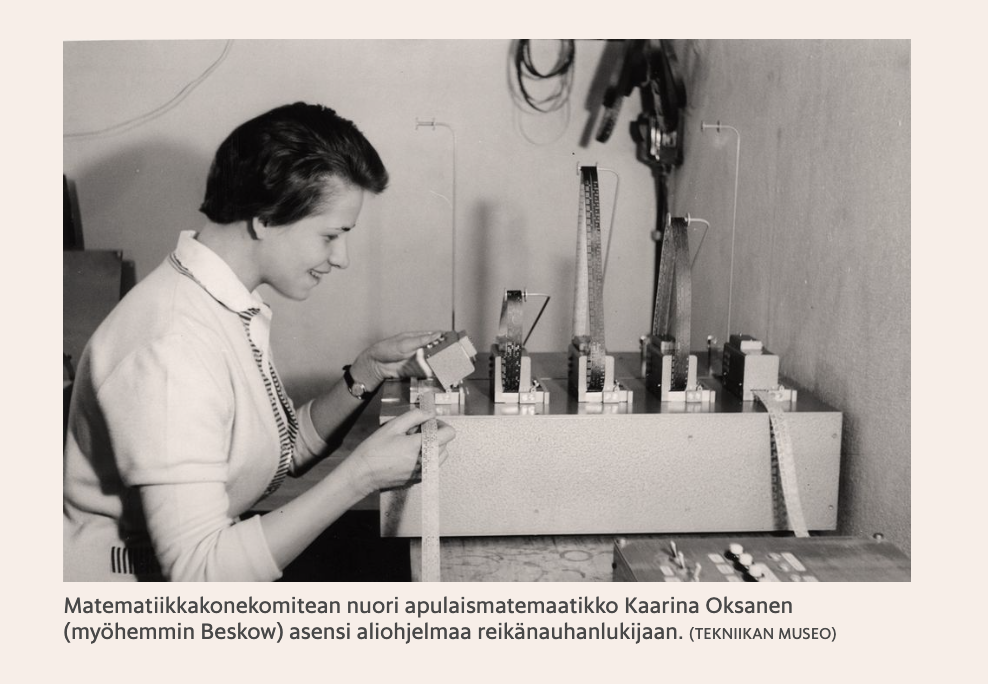
In a black-and-white photograph taken in the fifties, a young Kaarina Beskow carefully loads a program into the ESKO computer's punched tape reader.
To my mind, she's wrong.
The focused look on Beskow's face gives me faith in my own choice to become a programmer, 70 years later. Her quiet presence tells me that there is always uncertainty involved when creating something new and that the importance of one's own work isn't easy to assess.
Above all, the young Beskow, in her work on the Mathematical Machine Committee, builds a wistful chain of existence.
You were all here before me. You mattered.
And perhaps we've already seen the kind of world young men's code leads us to. Perhaps what we need is not progress, but maintenance.
Less ego, more conversation. More Maija-Liisas, Maritas, Tarus, and Kaarinas.
Translated by Christina Saarinen