No. 55 - Summer books ⫶ Endpapers ⫶ Bookalikes
Books create breadcrumbs
My name is Linda. I write a bi-weekly newsletter about computer science, childhood and culture - and there are 9688 of you listening. If you enjoy this issue, please share it with anyone you think may find it useful.
This year's reading has been a slump, with 37 books. Finishing anything has been a challenge, and maybe as a result, the books I have completed are mostly fiction. Hoping the other half of the year will offer an energy change.
I was thinking of doing the same thing as last year, making a recommendation list of pairs of books, but instead, I decided to interview myself with some of the By the Book questions from the New York Times, a column I read almost every week (Please share your answer in the comments or chat! Would love to learn more about the reading habits of this community)
What book is currently on your nightstand or at the top of your reading list?
On my nightstand, Herve Tullet’s biography Herve Tullet's Art of Play: Images and Inspirations from a Life of Radical Creativity - although it’s too heavy to read at bedtime, so on Kindle I have A Primer for Forgetting: Getting Past the Past by Lewis Hyde and on my ears Free Food for Millionaires by Min Jin Lee.
I always have several books going on at the same time. I like how books I'm reading triangulate with one another. And how some books create breadcrumbs for others.
Which book has had the biggest impact on your life, and why?
The Summer Book by Tove Jansson. (I was also lucky enough to read the new audio version in Finnish, so now, as the narrator, THE ALGORITHM always associates me with the book online. A goal!) It's the book I've re-read most. It has the most charm, tenderness, and wisdom packed into it. It's a reminder, a recital of what matters to me whenever I feel lost.
Are there any authors who have influenced your writing or thinking significantly?
Right now, as I'm working on my own non-fiction writing:
Seven Brief Lessons on Physics by Carlo Rovelli. This was the first book I read, with the tone and voice I wanted to use when discussing computer science and the multitude of disciplines, people, and experiences required to make the computer.
Turing's Cathedral by George Dyson. Dyson's writing is denser, but his stories that combine nature and computing never fail to inspire.
Gathering Moss by Robin Wall Kimmerer. I love the language and the structure in Kimmerer's books, how she doesn't shield away from the personal and subjective. I get inspired by many nature writers who describe science not through reason but through emotion. This kind of science writing also offers a context and keeps the why central, not the how.
Do you have any specific reading rituals or habits?
I always read with a pen. I scribble directly in the margins but often make a small index in a notebook (or Notes) and add thoughts or reflections. I enjoy reading seriously, and these notes help me think.
I also have reading soundtracks (Spotify made this easy enough!). Oh, and I use Readwise to remind me of specific writing passages.
What role do books and reading play in your life?
I like surrounding myself with books, whether the ideas or the physical form. Living in Paris, after my family, I miss my bookshelf the most.
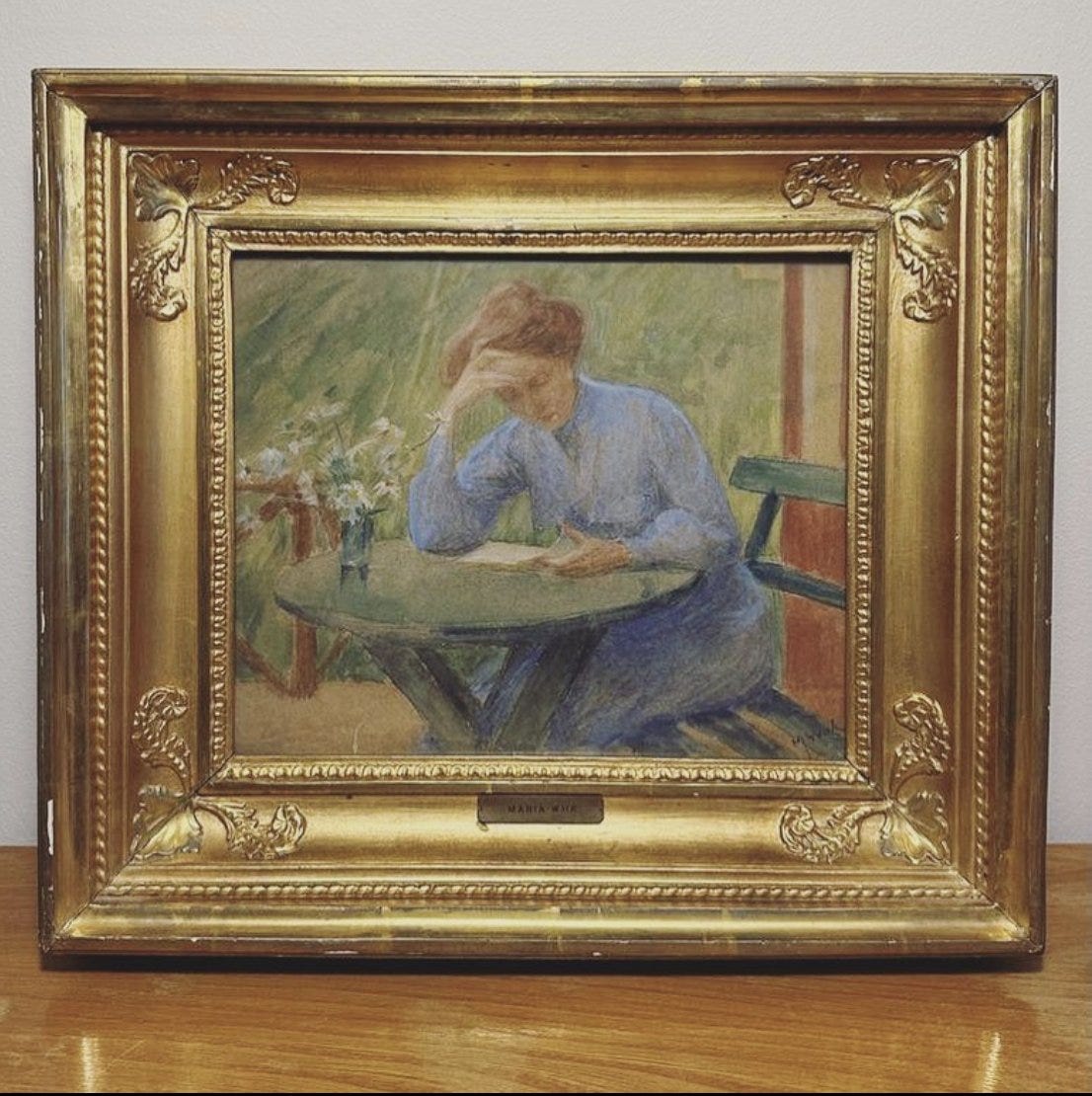
One of my favorite motifs for painting is a woman reading. So last Christmas, I purchased a small gouache painting by Maria Wiik (1953-1928). Wiik was a Finnish painter who worked and lived in Paris for long periods. I love the focus the lady in the painting has, the deep concentration on whatever she is immersed in. I got a few biographies on Wiik (she is fascinating - a friend of Schjerfbecks, but relatively unknown) and also Women Who Read Are Dangerous by Stefan Bollmann, which explores the subject in more than seventy artworks by artists such as Henri Matisse, Edward Hopper, Suzanne Valadon, August Sander, Rembrandt, and many more.
Books read in 2023
(Some linked books lead to Bookshop.org, and I earn a small commission each time someone uses the link to purchase a book.)
January
Malma station by Alex Schulman.
The Color Purple by Alice Walker. Loved this!
The White Book by Kang Han
France: An Adventure History by Graham Robb
Novelist as a Vocation by Haruki Murakami
Vaivan arvoista – esseitä poikkeuskirjallisuudesta by Ville-Juhani Sutinen.
The English Understand Wool by Helen DeWitt. Should read more novellas..
On Reading: Provocations, consolations and suggestions for reading more freely by Nick Parker
February
Four Seasons in Rome: On Twins, Insomnia and the Biggest Funeral in the History of the World by Doerr, Anthony. This was travel writing that stuck with me.
Trust by Hernan Diaz
Jaettu by Emilia Suviala
After Sappho by Selby Wynn Schwartz
March
Rusetti by Anu Kaaja
About Grace by Anthony Doerr
Rosa & Björk by Satu Rämö
Hävitys: tapauskertomus by Iida Rauma. Maybe my favorite fiction of the year so far.
12 Bytes: How We Got Here. Where We Might Go Next by Jeannette Winterson
Los Angeles -esseet by Aino Frilander. Loved these essays.
April
A Life's Work: On Becoming a Mother by Rachel Cusk
Yö Whistlerin maalauksessa by Joel Haahtela
Manuaali by Klaus Maunuksela
Collected Works by Lydia Sandgren. Enjoyed this a lot.
Teoriani perheestä by Juha Itkonen
Kehrä by Saila Susiluoto
The Details by Ia Genberg
Dreamland - A Self-Help manual by Andri Snaer Magnason
May
Once Upon a Prime: The Wondrous Connections Between Mathematics and Literature by Sarah Hart
The Cartographers by Peng Shepherd
Skynda att älska by Alex Schulman
Winter in Sokcho by Elisa Shua Dusapin
Memory of Water by Emmi Itäranta. I had meant to read this for a long time, glad I did.
Proust on Proust - Matka aikaan, paikkaan ja ihmiseen by Hannu Mäkelä
June
Yellowface by R.F. Kuang
The Storied Life of A.J. Fikry by Gabrielle Zevin
Den lodande människan. Havet, djupet och nyfikenheten: Essäer by Patrik Svensson
English Pastoral: An Inheritance by James Rebanks
The LEGO Story: How a Little Toy Sparked the World's Imagination by Jens Andersen
The Didomenico Fragment by Amor Towles
Linked List
In computer science, a linked list is a linear collection of data elements whose order is not given by their physical placement in memory. But here it is a selection of things I’ve been reading lately.
Bookalikes. are book covers that speak to one another. Many favorites here. (These are not about plagiarism but pairing, spotting, and celebrating connections).
Endpaper maps. Almost all books would benefit from a map. Here's a collection. (And this account focuses only on the endpapers of children's books, sans maps!)
Tech Book Publishing Experiments. A group of publishing experiments by people in tech by Samuel Arbesman.
Classroom
I’m hoping to surface and share stories from all of you and I’d love to see your creations! Here are a few teachers using Ruby in creative, fun and inspiring ways.
Taking a summer break! But if you’re an educator tasked with planning a summer reading challenge, here are the prompt questions I made for the Hello Ruby books:
