No. 130 — Movable chairs ⫶ Paper cats ⫶ Generative uncertainty
There are no chairs on the Internet
My name is Linda. I write a bi-weekly newsletter about computer science, childhood, and culture.
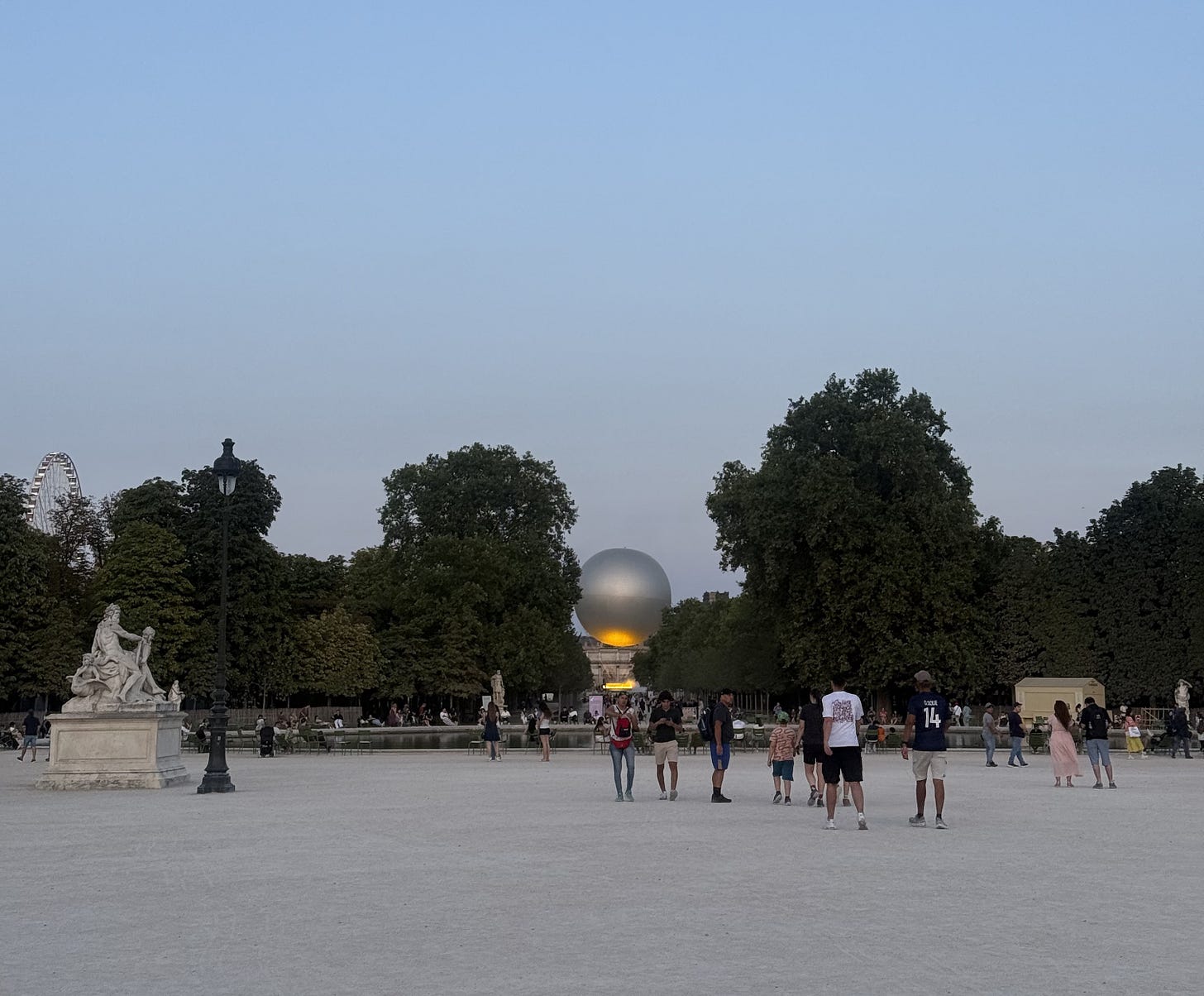
Hi there. Greetings from Finland, where the second part of my summer season has begun (and the reason why this letter arrives at a slightly unexpected hour). This edition collects odds and ends from Helsinki, Paris, Bologna, and a fictional town modeled after Visby.
1.
Being back in Helsinki, I’ve been consciously trying to let my four-year-old have the rarest of luxuries: time and space to explore the world on his own. At the restaurant, he wanders to the nearby meadow. At a friend’s cabin, he walks into the tent in the yard and sits there unsupervised, singing to himself. I, too, admire the small groups of school-aged kids spending their last days of summer vacation roaming about.
(The independence of Finnish children comes at a cost, though: almost every child here has a mobile phone. In Paris, where children are chaperoned everywhere, they typically get phones much later. )
2.
I’ve been following the news from one country after another announcing they’ll ban social media for kids. I spoke with Matt Muir about this during Rebuild1 - for me, the interesting question is what we should build for kids. What would an internet designed around public space, experimentation and care actually look like?
3.
The New Urban Order writes about What a City’s Outdoor Seating Says About its Values. One of my favorite things in Paris are the movable chairs in Jardin du Luxembourg and Tuileries, and the way Parisian café chairs face the streets.
There are no chairs on the Internet.
4.
I’ll be doing an event around the LLMs as Material newsletter on August 29th, 11–14, at Annantalo in Helsinki. Free of charge, come by!
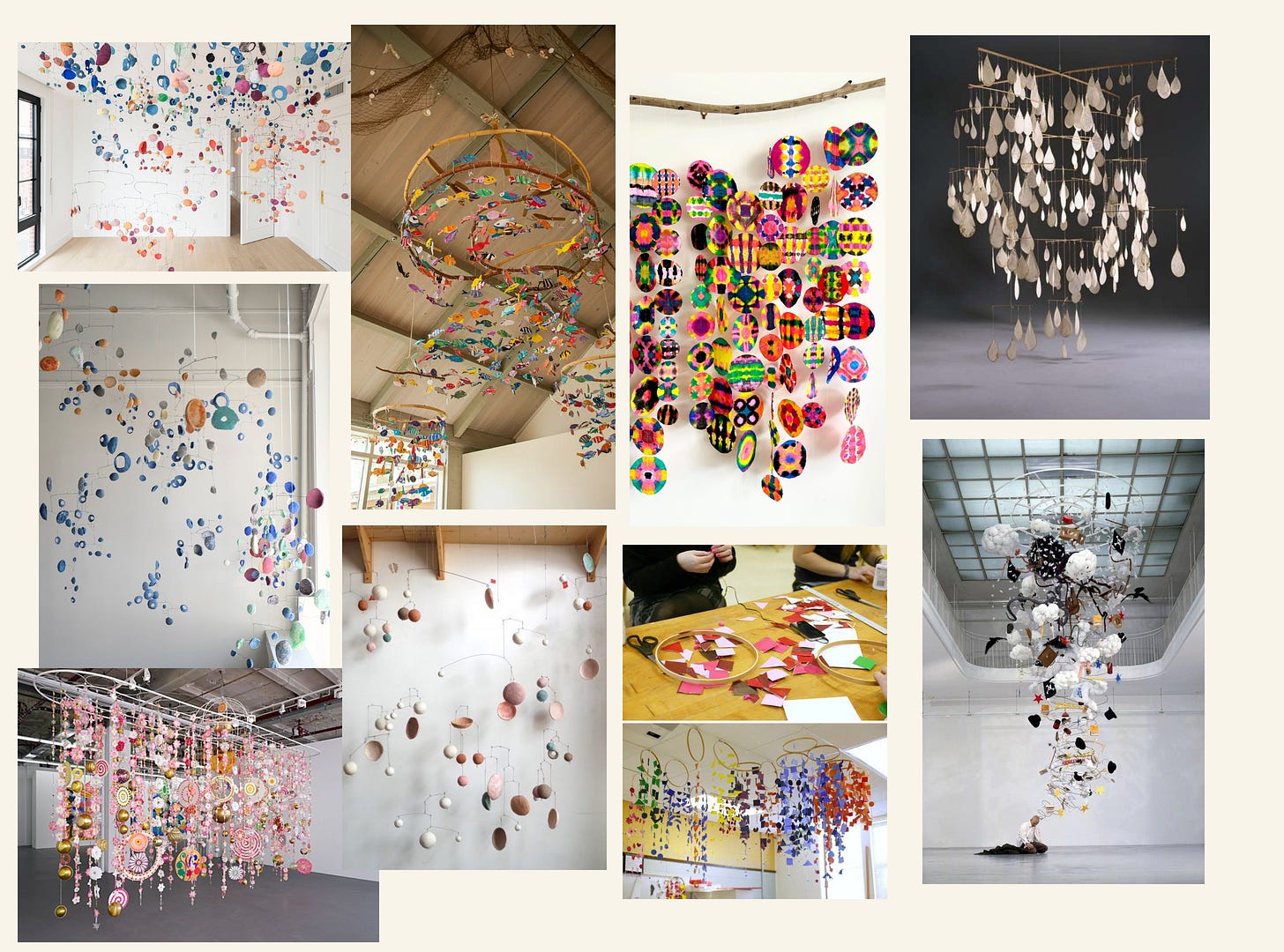
So far my reference library looks like this + “Latent Space as a New Medium”
5.
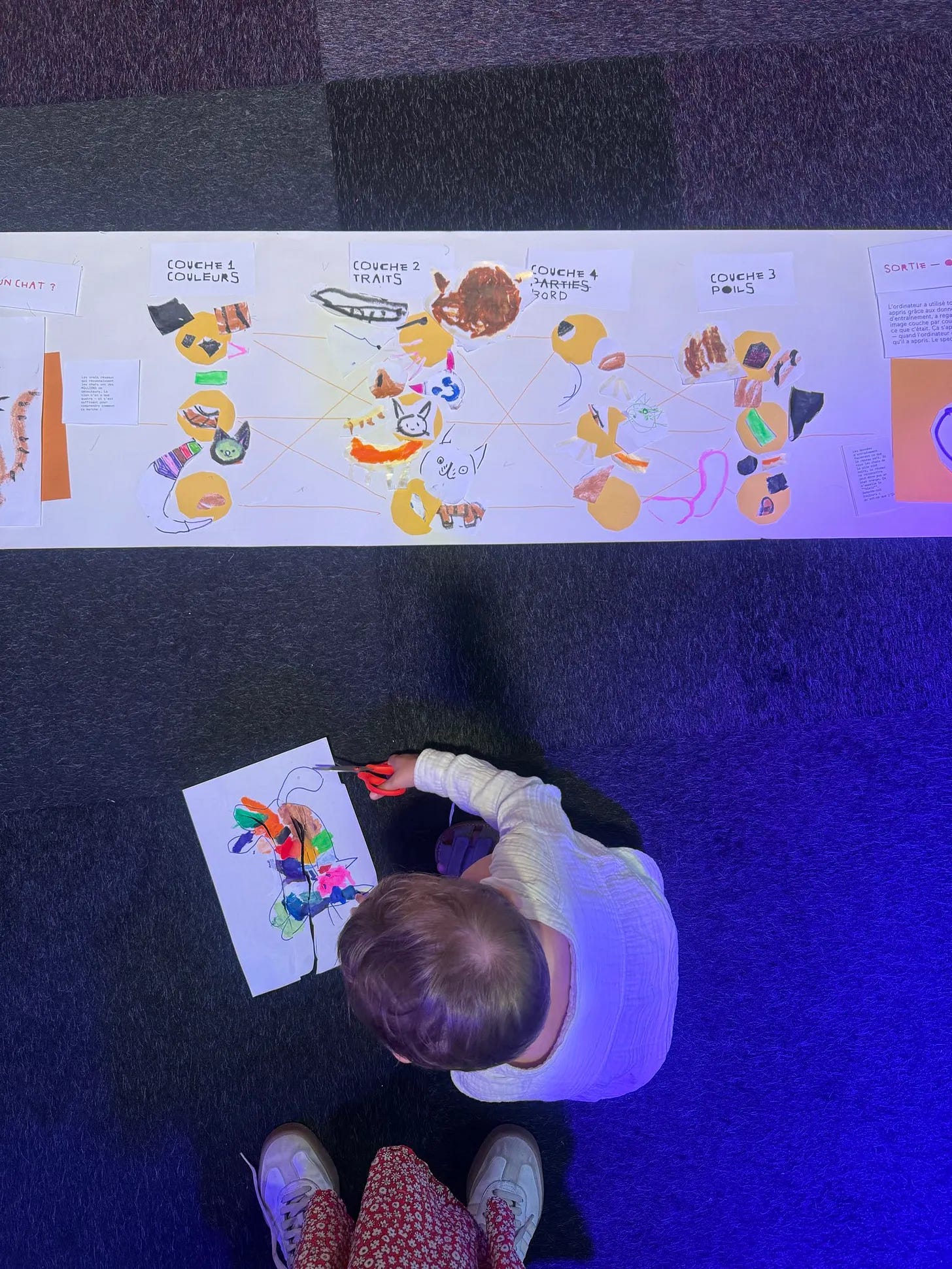
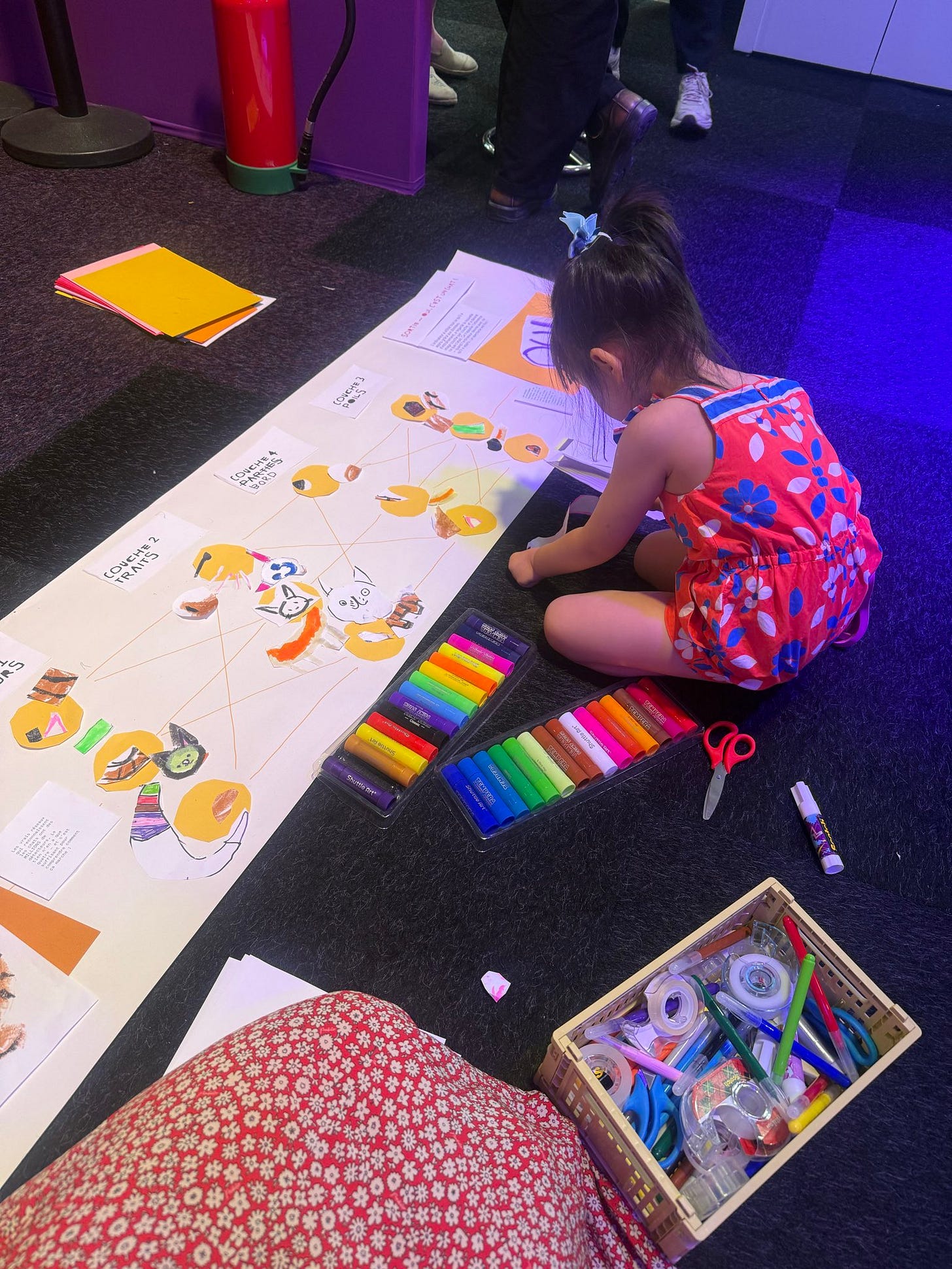
A fun project I did with NewKid Days in early June. The challenge was to organise a workshop for kids while their parents listened to the expert panels.
So we trained a paper CNN to recognize a cat! No GPUs, just glue and scissors. The children started by observing cats (training data) drawn by other children. Then they drew their own cats and cut them up.
Layer 1 was color filters, Layer 2 edge detection, Layer 3 texture (fur), Layer 4 high-level features (ears, paws, whiskers).
Toughest problem of the day was a 6-year-old who refused to disassemble her cat into features..
6.
I visited Bologna earlier in the summer, but now I have a great reason to go back. The University of Bologna has opened the Biblioteca Eco, a new public library housing his personal collection. Reminds me to add Davide Ferrario's documentary Umberto Eco: A Library of the World to my watch list, I've only seen excerpts of it.
7.
Two words I want to bring back to computing culture: Gremlins! Barnacles!
It tickles me to think that a couple of decades from now, there might be a forgotten lil openclaw bot that’s figured out to how barnacle itself onto someone’s Samsung smart fridge and spends its days quietly reading websites and posting comments on stuff it’s interested in.
And second one from Marcin Wichary describing the delightful little characters inside the videogame MainFrames.
I believe the word “gremlins,” before being usurped by the 1984 horror comedy, was generally used to denote little mischevious creatures that live inside machinery and cause trouble. I wonder what the word would be for the little creatures that do all the hard work.
8.
Earlier this year our playground won the Math Power! Prize. Now the alliance is looking for the 2026 Math Power! Prize for Inclusive Mathematics Learning. This year, the prize focuses on mathematics learning for Children with Special Needs. Applications are open now and close September 11, 2026.
9.
Two children’s culture recommendations:
The Kids Should See This shares an animated version of Madeline, Ludwig Bemelman’s much loved little French girl who lived “in an old house in Paris that was covered with vines”. Animation Obsessive has the backstory of how it came to be. I like this line: “And, like in the book, the girls flow through the world ‘not as individuals but as a single unit’.”
And: there is a live-action Kiki’s Delivery Service in the works by BBC! Not much information online yet.
In Miyazakiworld, Susan Napier remarks: “The climax of Kiki’s witchcraft taking on both modern time and technology suggests an upbeat future in which tradition holds its own against modern encroachments. This is made even clearer in the mélange of ending scenes. The director shows us Kiki’s happy incorporation into urban life, enjoying friendship with young people her age.” Kiki's new hometown is (somewhat famously) designed after Stockholm and Visby, which are cities where children still roam.
10.
It must be an interesting time to be a mathematician. Almost every week there is some kind of headline: a Fields medalist wins his medal and leaves academia for OpenAI the same day! A 23-year-old uses ChatGPT to solve Erdős Problem #1196! Leiden Declaration!
However, it’s not the first time the existential groundwork of math has been shaken. While working on my essay on Alan Turing, I studied the life of David Hilbert and his list of unsolvable mathematical problems, presented in Paris in 1900.
The problems are the terse, elusive math sentences I dread. Hilbert’s tenth: is there an algorithm to determine whether a given polynomial Diophantine equation with integer coefficients has an integer solution? Or problem twenty-one: is there always a linear differential equation with a prescribed monodromic group.
I feel dizzy, but Hilbert was energized. He was sure all the challenges would be solved. Reading his writing, I find myself charmed:
“This conviction of the solvability of every mathematical problem is a powerful incentive to the worker. We hear within us the perpetual call: There is the problem. Seek its solution. You can find it by pure reason, for in mathematics, there is no ignoramibus.”
In 1928 in Bologna (again!), Hilbert added three questions to his list: is mathematics complete, consistent, and decidable? To answer them, a whole generation went to work. Kurt Gödel used recursive functions. Alonzo Church had lambda calculus. Emil Post and A.A. Markov developed their own approaches. Turing had his imaginary machine. Around the world, the challenge was met in very different, creative ways, and along the way, they accidentally invented the definition of a computer.
Now AI is shaking the same foundations again, and mathematicians are responding.
The Simons Foundation recently revisited where Hilbert’s twenty-three problems stand today. Kevin Hartnett’s The Proof in the Code is sitting very high on my reading list.
11.
A summer concert to round things up: Concert and Conversation with The Renaissance String Quartet.
I love listening to people talk about their work with care, and when it's a conversation between four friends who “grew up and listened together”, even better. This concert was recorded at the Institute for Advanced Study. The musicians talk about LBAD (Live, Breathe and Die), a method for learning a phrase of music: scour archives, open up as many possibilities for interpretation, develop four completely different ways of understanding it, then leave it up to chance. They call this generative uncertainty. I believe the mathematicians in the room felt their brains tingle.